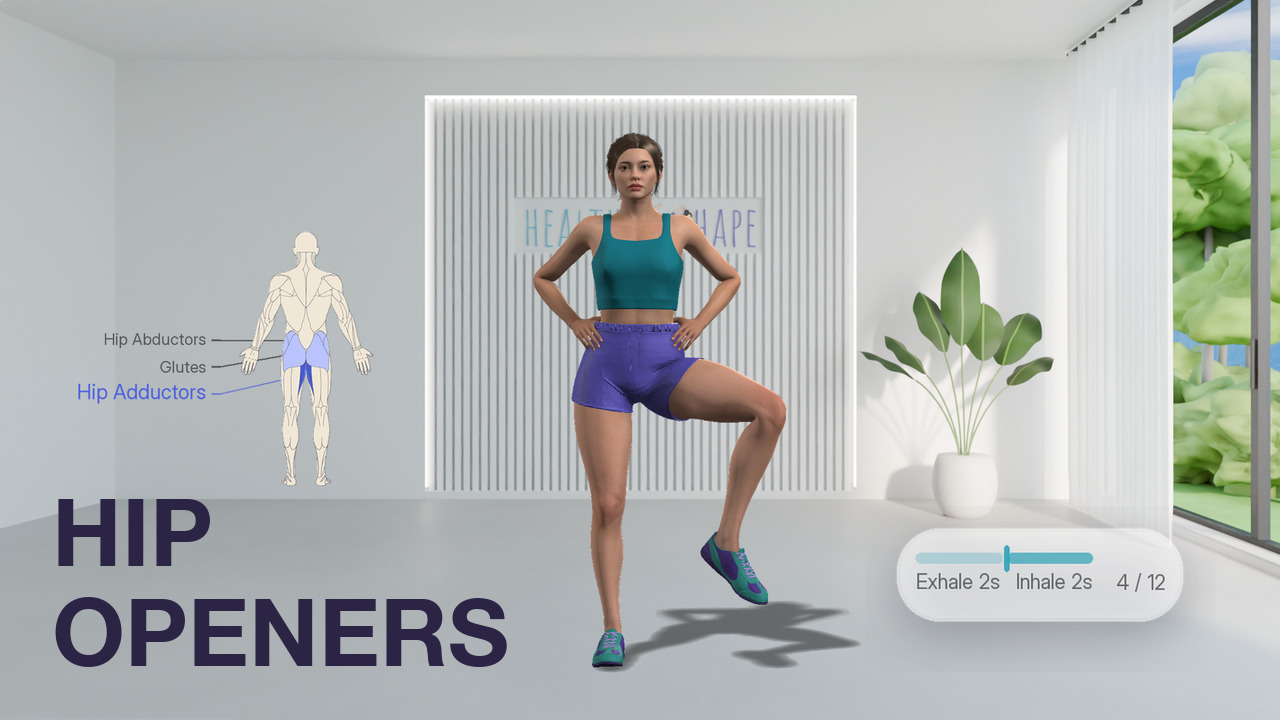
Hip openers are a standing mobility drill for your hips and inner thighs: stand on one leg with the other knee up at hip height and your hands on your hips, open the knee out to the side, then bring it back to the front, slowly and smoothly. They need no equipment, work four muscle groups when done with good form, and suit beginners as part of a warm-up or a mobility routine, whether at home, in the gym or outdoors.
This guide accompanies our video lesson above. The video teaches the movement at the speed it is really performed, mostly from the front, where you can see the knee open out to the side and come back, and also from the side, where the tall torso and the knee bent to 90 degrees show. Then it explains the muscles at work, the breathing and the tempo, and names the three most common mistakes, each with the cue that fixes it. Last come twelve hip openers at full speed, from all four camera angles, for you to follow along with before you switch legs.
How to do hip openers, step by step
- Set up. Stand tall with your feet hip-width apart and your hands on your hips. Engage your core and focus on your balance.
- Lift one knee. Shift your weight onto your standing leg and lift the other knee to hip height, bent to about 90 degrees.
- Open the knee out to the side. Take about two seconds to open it, slowly and smoothly, so that the movement comes from your hip.
- Bring it back to the front. With no pause, bring the knee back to the front in about two seconds.
- Stay tall. Keep your torso upright and facing forward, with the knee at hip height and bent to about 90 degrees. Your hip turns, not your trunk.
- Repeat, then switch legs. Keep the knee up between repetitions. Finish your repetitions on one leg, then do the same on the other.
Muscles worked in hip openers
Hip openers are a mobility drill for the hip joint, and four muscle groups share the work: the inner thighs lead as the target muscles, and the hip flexors, outer hips and glutes assist them.
- Inner thighs: the hip adductors (the adductor longus, adductor brevis and adductor magnus) lengthen as the knee opens, then bring it back to the front.
- Hip flexors: the psoas major keeps your knee up at hip height.
- Outer hips: the hip abductors (the gluteus medius, gluteus minimus and tensor fasciae latae) help open the knee out to the side, and on your standing leg they keep your hips level.
- Glutes: the gluteus maximus turns your hip out.
Breathing and tempo: 2 out, 2 back
Every repetition follows the same rhythm and takes about four seconds:
- Out, 2 seconds: breathe out as you open the knee to the side.
- Back, 2 seconds: breathe in as you bring it back to the front.
- No pause: each repetition flows straight into the next.
A slow, even rhythm keeps the movement controlled and your balance steady, and spares your hips and knees the jerky movements that strain them. Keep the same tempo on every repetition, and don’t speed up as you go.
3 common hip opener mistakes and how to fix them
- Rushing the movement. If you rush it, slow down: two seconds out, two seconds back. Cue: “slow down”.
- Losing your balance. If you lose your balance, brace your core to steady yourself on your standing leg. Cue: “brace your core”.
- Turning the trunk. If your trunk turns with the knee, keep your torso upright and facing forward, and move from the hip. Cue: “move from the hip”.
Sets, reps and variations
As part of a warm-up or a mobility routine, 2 to 3 sets of 8 to 12 repetitions on each leg are typical, with about 30 seconds of rest between sets. You count them in repetitions rather than seconds, and do them without added weight. A good first set is the one in the video: twelve hip openers, then twelve more on the other leg.
- Easier: don’t open the knee as wide, or keep one hand on a wall or a chair for support.
- Harder: open the knee wider, move even more slowly, or challenge your balance, for example by closing your eyes, with a wall within reach.
Safety
Avoid excessive or jerky movements to protect your hip and knee joints. If you have an acute hip or groin problem, or trouble with your balance, go carefully or consult a professional first. If you need support, stand next to a wall or a sturdy chair you can steady yourself on.
Your turn
Play the video above and do twelve hip openers with the coach, at the speed you would really do them: torso tall, knee at hip height and the movement coming from your hip. Then switch legs and do twelve more. Which hip felt tighter, left or right? Tell us in the comments under the video on YouTube. If this lesson helped, subscribe to HealthyShape on YouTube for a new exercise lesson every week. Every exercise in the HealthyShape app carries the same muscle view and tempo guide you see in the video.