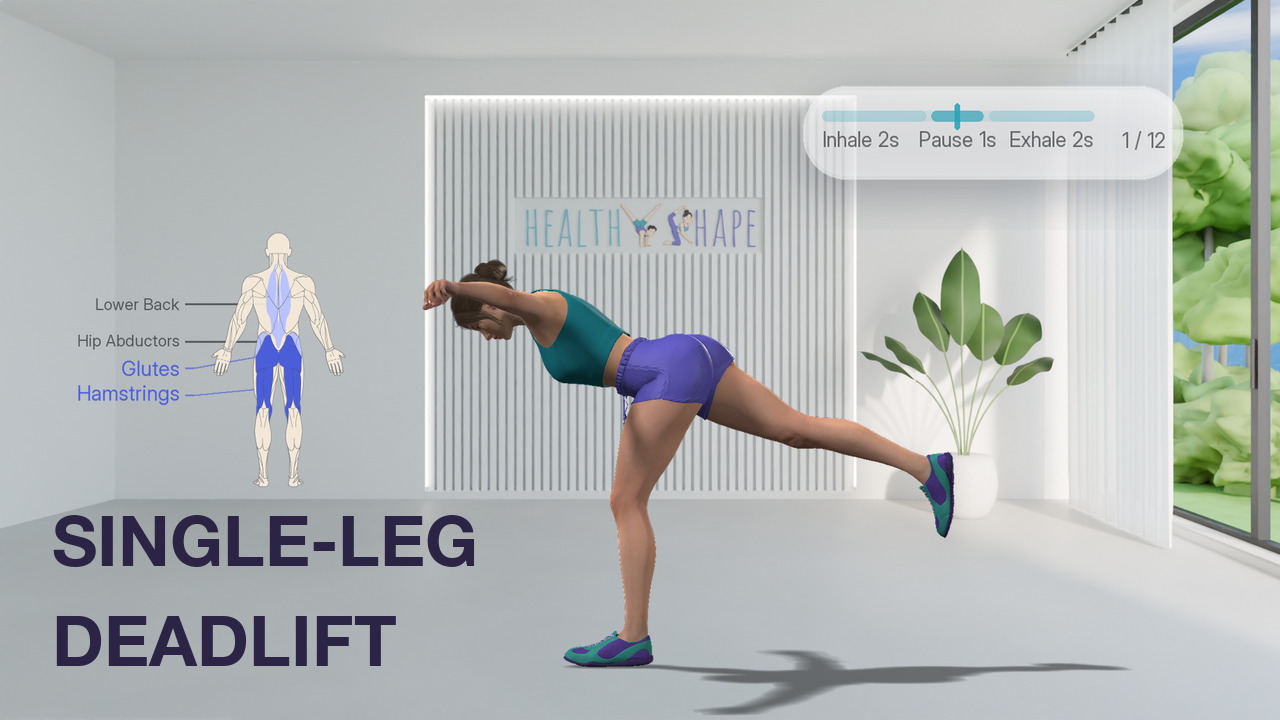
The single-leg deadlift is a hip hinge on one leg for your hamstrings and glutes: with your standing knee slightly bent, push your hips back and lower your torso as your free leg extends straight behind you, then drive your hips forward to stand. It needs no equipment, works four muscle groups when done with good form, and trains your strength and your balance together, at home, in the gym or outdoors.
This guide accompanies our video lesson above. The video teaches the movement at the speed it is really performed, mostly from the side, the view a hip hinge is judged from: the hips going back, the free leg straight behind you and the flat back. From the front, it shows the arms opening out for balance. Then it explains the muscles at work, the breathing and the tempo, and names the four most common mistakes, each with the cue that fixes it. Last come twelve single-leg deadlifts at full speed, from all four camera angles, for you to follow along with before you switch legs.
How to do a single-leg deadlift, step by step
- Set up. Stand tall with your feet hip-width apart and your arms relaxed at your sides. Shift your weight onto one leg, keep a slight bend in that knee and engage your core.
- Push your hips back. Start the movement at the hips: push them back as your free leg lifts and extends straight behind you, keeping your back flat, your chest up and your hips square.
- Open your arms for balance. As you lower, open your arms out to the sides until they form a T at the bottom with your palms facing the floor.
- Lower to the stretch and pause. Take about two seconds to lower your torso until you feel a stretch in the hamstrings of your standing leg, or until your torso is nearly parallel to the floor, then pause for one second.
- Drive your hips forward. After the pause, drive your hips forward and return to standing in about two seconds, with control.
- Repeat, then switch legs. Keep your free foot off the floor between repetitions. Finish your repetitions on one leg, then do the same on the other.
Muscles worked in a single-leg deadlift
The single-leg deadlift is a hip hinge on one leg, and four muscle groups share the work: the hamstrings and glutes are its target muscles, with the hamstrings in the lead, and the lower back and outer hips assist them.
- Hamstrings: these three muscles at the back of the thigh (biceps femoris, semitendinosus and semimembranosus) lengthen as you lower and help bring you back up.
- Glutes: the gluteus maximus drives your hips forward to stand.
- Lower back: the erector spinae keep your back flat the whole way.
- Outer hips: the hip abductors (the gluteus medius and minimus) keep your hips level and steady you on your standing leg.
Breathing and tempo: 2-1-2
Every repetition follows the same rhythm and takes about five seconds:
- Down, 2 seconds: breathe in as you hinge forward and lower your torso.
- Pause, 1 second: at the bottom, where you feel the stretch.
- Up, 2 seconds: breathe out as you drive your hips forward to stand.
That rhythm is what turns movement into training: the slow way down and the pause keep your muscles working under control, and moving slowly helps you stay balanced on one leg. Keep the same tempo on every repetition, and don’t speed up as you tire.
4 common single-leg deadlift mistakes and how to fix them
- Rounding the back. If your back rounds, keep your chest up and lower only as far as your back stays flat. Cue: “chest up”.
- Locking the standing knee. If you lock your standing knee, keep a slight bend in it. Cue: “keep a slight bend”.
- Letting the hips twist. If your hips twist open, keep them square to the floor. Cue: “hips square”.
- Losing your balance. If you lose your balance, slow down and move with control. Cue: “slow down”.
Sets, reps and variations
For general fitness, 2 to 4 sets of 8 to 12 repetitions on each leg are typical, with about 60 seconds of rest between sets. Focus on the quality of each repetition rather than the number. It is an intermediate exercise: if your balance is not yet steady, start with one of the easier options below. A good first set is the one in the video: twelve single-leg deadlifts at the 2-1-2 tempo, then twelve more on the other leg.
- Easier: do the same hip hinge on both feet, keep one hand on a wall or a chair for support, or don’t lower as far.
- Harder: add weight with a dumbbell or a kettlebell, lower through a bigger range of motion, or train barefoot to challenge your balance.
Safety
Keep your spine neutral: never let your back round or your hips twist open. Use only your body weight until you have mastered the form. If you have lower-back, hamstring or balance problems, consult a professional before doing single-leg deadlifts.
Your turn
Play the video above and do twelve single-leg deadlifts with the coach, at the speed you would really train: back flat, hips square and arms out for balance. Then switch legs and do twelve more. How many could you do without touching down? Tell us in the comments under the video on YouTube. If this lesson helped, subscribe to HealthyShape on YouTube for a new exercise lesson every week. Every exercise in the HealthyShape app carries the same muscle view and tempo guide you see in the video.