The bodyweight squat is the foundation of lower-body training: push your hips back, lower until your thighs are parallel to the floor, and stand back up. It needs no equipment, works eight muscle groups at once when done with good form, and suits beginners, at home or in the gym.
This guide accompanies our video lesson above. The video teaches the squat from four camera angles, slowed down so every cue is easy to follow, then explains the muscles at work, the tempo and where the breath goes, and names the four most common mistakes, each with the cue that fixes it. Then come twelve repetitions at full speed for you to follow along with.
How to do a squat, step by step
- Set up. Stand tall with your feet shoulder-width apart and your toes pointing slightly outward. Extend your arms straight out in front of your chest for balance, keep your chest up and brace your core.
- Push your hips back. Start the movement by sending your hips back and bending your knees, as if you were sitting into a chair.
- Keep your knees in line with your toes. As you lower, your knees track over your toes. Never let them fall inward.
- Lower to parallel. Take about two seconds to lower until your thighs are parallel to the floor, keeping your spine neutral the whole way.
- Pause at the bottom. Stay there for one second, in control.
- Drive through your heels. Push the floor away through your heels and return to standing in about one second.
Muscles worked in a squat
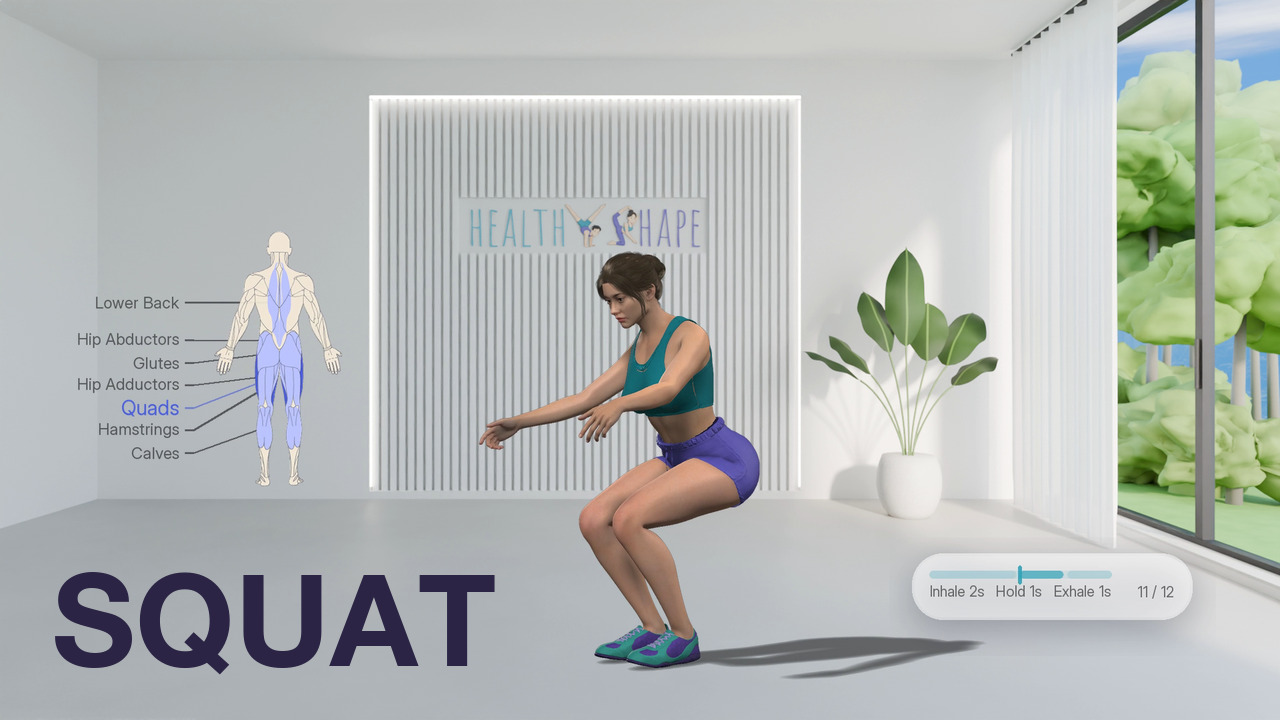
The squat is a compound, knee-dominant movement, and eight muscle groups share the work: the quadriceps lead, and seven more groups assist them.
- Quadriceps: the target muscles. These four muscles across the front of the thigh (rectus femoris, vastus lateralis, vastus intermedius and vastus medialis) lift you out of the bottom.
- Glutes and hamstrings: they drive your hips forward as you stand up.
- Hip adductors and abductors: the muscles of the inner thighs and the outer hips keep your hips stable through the whole range.
- Abs and lower back: the rectus abdominis and the erector spinae hold your torso tall and your spine neutral.
- Calves: they anchor the whole movement to the floor and keep you balanced.
Tempo and breathing: 2-1-1
Every repetition follows the same rhythm and takes about four seconds:
- Down, 2 seconds: breathe in as you lower.
- Pause, 1 second: at the bottom, with your thighs parallel to the floor.
- Up, 1 second: breathe out as you drive through your heels.
That rhythm is what turns movement into training: the slow way down and the pause keep your muscles working under control instead of letting momentum do the job. Keep the same tempo on every repetition, and don’t speed up as you tire.
4 common squat mistakes and how to fix them
- Rounding the back. If your back rounds, lift your chest and it straightens. Cue: “chest up”.
- Knees caving in. If your knees fall inward, push them out so they stay in line with your toes. Cue: “knees out”.
- Rising onto the toes. If your heels come up, shift your weight back into them. Cue: “weight in heels”.
- Not reaching depth. Go deep enough that your thighs reach parallel to the floor, within your own mobility. Cue: “thighs parallel”.
Sets, reps and variations
For general fitness, 2 to 4 sets of 8 to 20 repetitions are typical, with about 60 seconds of rest between sets. Adjust the volume and the rest to your goal: strength, endurance or muscle growth. A good first set is the one in the video: twelve repetitions at the 2-1-1 tempo.
- Easier: squat down to a chair for support, or reduce the depth.
- Harder: add weight with dumbbells or a barbell, do more repetitions, or try single-leg variations.
Safety
Keep your spine neutral throughout, don’t let your knees cave in or your heels lift, and don’t go deeper than your mobility allows. If you have knee, hip or lower-back problems, consult a professional before doing squats.
Your turn
Play the video above and do twelve repetitions with the coach, from all four angles, at the speed you would really train. If this lesson helped, subscribe to HealthyShape on YouTube for a new exercise lesson every week. Every exercise in the HealthyShape app carries the same muscle view and tempo guide you see in the video.