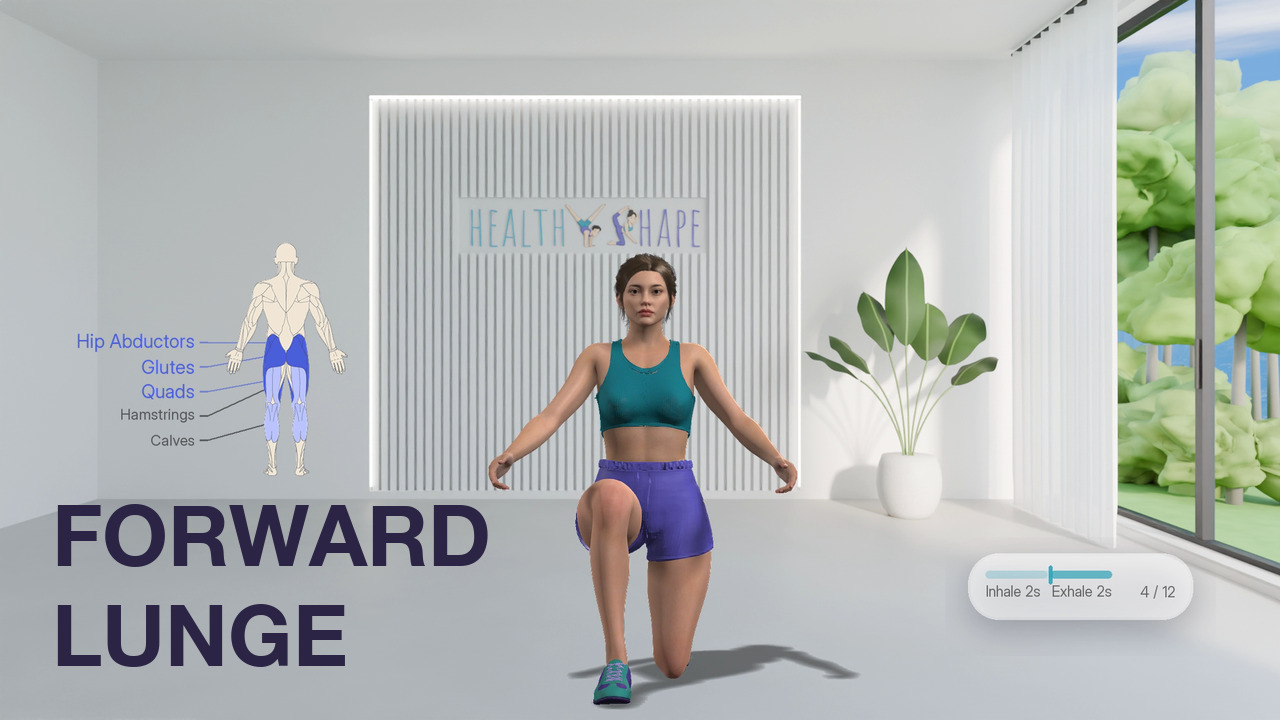
The forward lunge is a staple of lower-body training: step forward, lower until your back knee hovers just above the floor, and push back to the starting position. It needs no equipment, works five muscle groups when done with good form, and suits beginners, at home, in the gym or outdoors.
This guide accompanies our video lesson above. The video teaches the forward lunge from four camera angles, on both legs, slowed down so every cue is easy to follow, then explains the muscles at work, the tempo and where the breath goes, and names the four most common mistakes, each with the cue that fixes it. Then come twelve repetitions at full speed, alternating legs, for you to follow along with.
How to do a forward lunge, step by step
- Set up. Stand tall with your feet shoulder-width apart and your arms relaxed at your sides. Draw your shoulders back, keep your chest up and engage your core.
- Step forward, heel first. Take a long step forward with one leg and land on your heel, not your toes.
- Lower until the back knee hovers. Bend both knees and lower until your front thigh is parallel to the floor and your back knee hovers just above it. The step and the descent together take about two seconds.
- Keep your torso upright. Your chest stays up and your core engaged all the way down, and your front knee stays over your ankle.
- Push through the front heel. With no pause at the bottom, push through the heel of your front foot to return to the starting position in about two seconds.
- Switch legs. Do the next repetition with the other leg, and keep alternating.
Muscles worked in a forward lunge
The forward lunge is a compound lower-body movement, and five muscle groups share the work: the quadriceps, glutes and hip abductors are its target muscles, with the quadriceps in the lead, and the hamstrings and calves assist them.
- Quadriceps: these four muscles across the front of the thigh (rectus femoris, vastus lateralis, vastus intermedius and vastus medialis) lift you out of the bottom.
- Glutes: the gluteus maximus drives your hips back up to standing.
- Hip abductors: on the outer hip, the gluteus medius, with the gluteus minimus, keeps your hips level and helps your front knee track straight.
- Hamstrings: they assist from the back of the thigh as you rise.
- Calves: they keep your front foot steady on the floor.
Tempo and breathing: 2-0-2
Every repetition follows the same rhythm and takes about four seconds, with the step forward counted in the way down and the step back in the way up:
- Down, 2 seconds: breathe in as you step forward and lower.
- No pause: as soon as your back knee hovers above the floor, start back up.
- Up, 2 seconds: breathe out as you push back to the starting position.
That rhythm is what turns movement into training: two controlled seconds each way keep your muscles working instead of letting momentum do the job. Keep the same tempo on every repetition, and don’t speed up as you tire.
4 common lunge mistakes and how to fix them
- Front knee caving in. If your front knee falls inward, keep it over your ankle. Cue: “knee over the ankle”.
- Leaning forward. If your torso tips forward, lift your chest and brace your core. Cue: “chest up, core braced”.
- A step too short or too long. Adjust the length of your step so that both knees bend to 90 degrees. Cue: “both knees at 90°”.
- The back knee slamming down. Never let your back knee drop onto the floor: lower with control until it hovers just above the floor. Cue: “lower with control”.
Sets, reps and variations
For general fitness, 2 to 4 sets of 8 to 15 repetitions, alternating legs, are typical, with 60 to 90 seconds of rest between sets. Adjust the volume and the rest to your fitness level and your goal. A good first set is the one in the video: twelve repetitions, six on each leg, at the 2-0-2 tempo.
- Easier: don’t lower as far, or keep one hand on a wall or a sturdy chair for balance.
- Harder: add weight with dumbbells or a barbell, do more repetitions, or move on to walking lunges.
Safety
Keep your front knee over your ankle, lower your back knee with control instead of letting it hit the floor, and keep your torso upright. If you have a knee or hip injury, consult a professional before doing lunges.
Your turn
Play the video above and do twelve repetitions with the coach, alternating legs, at the speed you would really train: six on each leg make one set. If this lesson helped, subscribe to HealthyShape on YouTube for a new exercise lesson every week. Every exercise in the HealthyShape app carries the same muscle view and tempo guide you see in the video.